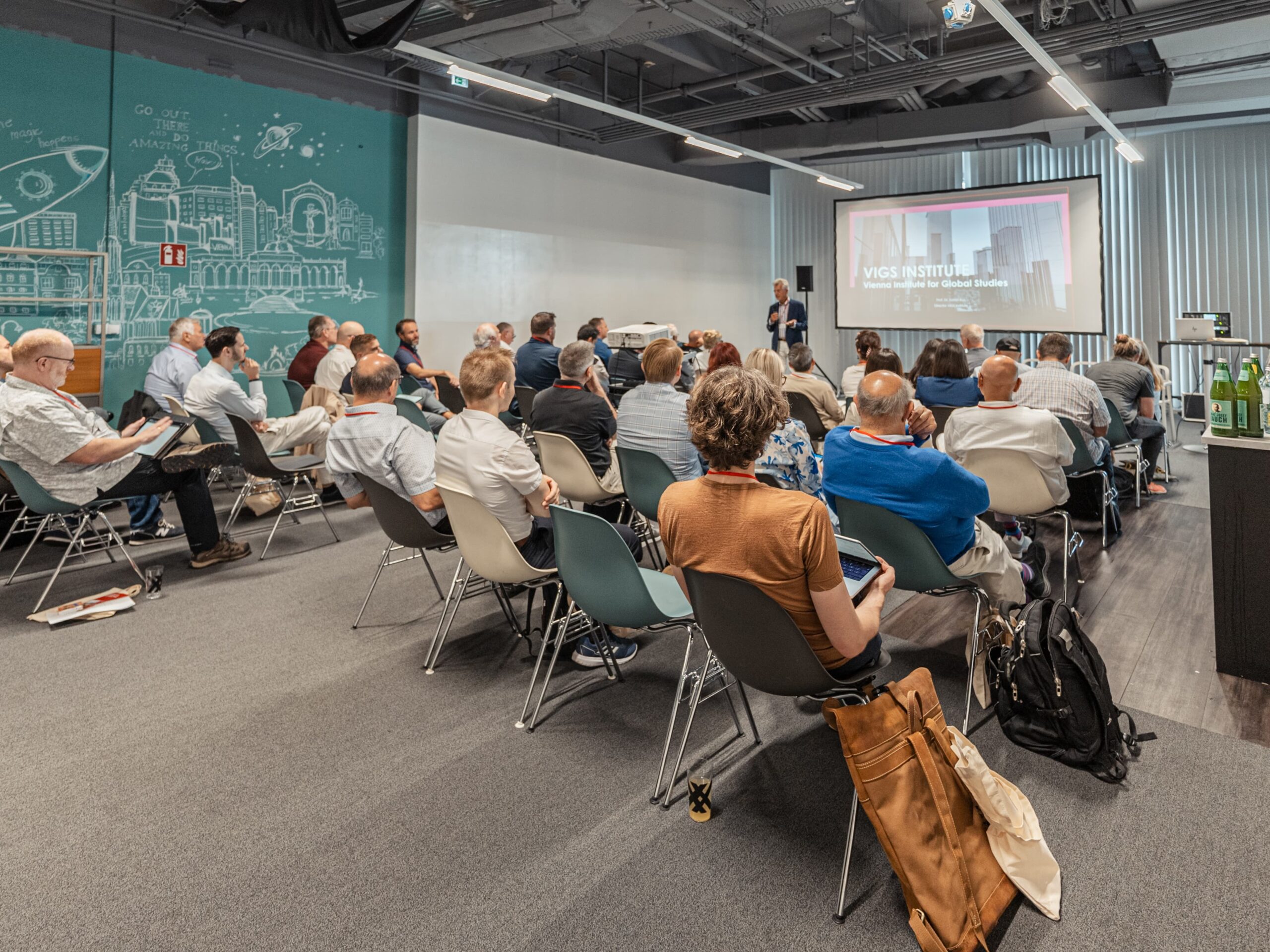
The Vienna Institute for Global Studies (VIGS), together with Péter Kovács, organized an exclusive panel discussion titled “The Future of Money” at the WeXelerate innovation hub in Vienna. The event convened leading economists, investors, technologists, and geopolitical thinkers to explore the seismic shifts transforming how the world earns, stores, and spends money in a digital-first era.
From the rise of cryptocurrencies to central bank digital currencies (CBDCs), the discussion tackled how these innovations are reshaping power structures, societal norms, and the global financial order.
Opening Remarks: A Wake-Up Call for the 21st Century
Prof. Dr. Zoltán Ács, Director of Vienna Institute for Global Studies, opened the event with a pointed reminder that beneath the buzzwords such as AI, Fintech, and crypto lies a more profound shift in the foundations of our economies and societies.
“Money is not just a means of transaction; it is a mirror of our values and structures,” Ács said. “We’re at a point where financial systems are no longer evolving. They’re being rebuilt from the ground up.”
VIGS, founded to explore the complex intersections between entrepreneurship, well-being, and global systems, aims to cut through surface-level narratives and bring forward grounded, interdisciplinary analysis. This panel continued that mission by connecting economics with ethics and technology with politics.
Global Perspectives: Money Through a Multinational Lens
- Hubertus Hofkirchner – Founder & CEO, Bitcredit (Austria)
- Alex Lin – FinTech investor & innovation leader (Singapore)
- Daniel Ospina – Co-founder & CIO, Pygma (Colombia)
Moderator: Amit Pradhan – Founder & CEO, Rainfall; President, Silicon Valley Blockchain Society (USA)
Keynote: Two futures for money
Hofkirchner argued the technology is largely settled—digital, mobile, biometric, cryptographic. The real fork lies in economics:
- Fiat status quo: Central-bank monopolies, floating FX, policy-driven booms/busts, asset bubbles, and growing surveillance through digital rails. He warned that weaponized compliance and “de-banking” create fragility in trade and squeeze SMEs and developing markets.
- “Hard-money” path: A base layer like Bitcoin plus an elastic, credit layer tied to real goods (bills of exchange), allowing money supply to expand/contract with production, stabilizing prices without central planning. In this view, privacy and self-custody are essential guardrails against censorship.
His bottom line: absent deliberate choices, we drift toward more control. A hard-money architecture offers a freer, more resilient alternative.
Panel highlights
1) Culture and infrastructure drive adoption
Moderator Amit Pradhan widened the aperture: from Sweden’s near-cashless reality to Africa’s leapfrog into mobile money, financial behavior mirrors cultural norms and state capacity. He predicted less visible paying ahead as agentic AI optimizes subscriptions, negotiates plans, and executes transactions in the background, subject to our preferences and local rails.
2) Asia’s “platform wallets” show the path
Alex Lin traced how payments in Asia often hitchhiked on platforms (e.g., ride-hailing and commerce). Money stays inside ecosystems, compounding utility until the “payments business” eclipses the original service. His cautionary note: the AI-crypto mix is potent, cross-border earnings in dollar-linked instruments can erode local monetary sovereignty faster than policymakers expect.
3) Latin America’s stepwise transition
Daniel Ospina described a pragmatic ladder: move people from cash to simple fiat e-wallets (Brazil’s PIX as a benchmark), then to stablecoins for cross-border spending and saving (e.g., USDC), with startups smoothing on-/off-ramps and UX. In environments with inflation or weak banking access, stablecoins are often the bridge to broader Web3 participation.
4) Regulation, trust, and the “hybrid” reality
The group agreed that enforcement concentrates on the on/off-ramps (KYC/AML at exchanges and issuers). While Hofkirchner champions privacy-preserving cash-like tools (eCash) as a democratic necessity, Pradhan expects a hybrid world: strong identity for regulated access plus private, censorship-resistant options, letting society balance safety with freedom.
Audience moments that mattered
Volatility vs. viability: Asked when Bitcoin might “stabilize,” Hofkirchner argued size isn’t the key; building a credit layer for real trade atop a hard base (as gold once had) is.
Shadow economy concerns: The panel separated tools from institutions: cash remains the criminal’s best friend; digital enforcement focuses on gateways. Better design not blanket surveillance is the path to legitimacy.
Too many apps, too little trust: For attendees overwhelmed by wallets, the advice was clear: expect the interface to simplify. AI agents and cleaner UX will abstract complexity; self-custody and selective intermediaries will coexist.
Five-year forecasts
Hofkirchner: A “wild” period: fiat devaluation risks and fragmented private currencies, before better systems consolidate.
Ospina: Instant, near-free international payments become normal; cross-border commerce expands.
Lin: Your “walleted” life will make switching phones painful; platform lock-in gets worse before it gets better.
Pradhan: You’ll interact less with money; AI will handle more of it under your guardrails.
Why this conversation matters
The disappearance of cash isn’t just a UX upgrade; it’s a rewrite of who controls value, identity, and participation. VIGS’ session made three things plain:
Design choices are destiny. Privacy, programmability, and settlement finality aren’t technical footnotes; they’re civic values.
Regional realities differ. Asia’s platform economics, Latin America’s stablecoin pragmatism, and Europe’s institutional caution will produce different “futures” that still interoperate.
Agency shifts to the edge. From self-custody to AI assistants, control is moving closer to individuals if we build it that way.
VIGS’ role: at the intersection of entrepreneurship, well-being, and geopolitics, is to keep that debate grounded in real trade-offs, not hype. As Pradhan closed with Buckminster Fuller’s challenge: we’re called to be architects of the future, not its victims. The tools are here; the architecture is up to us.
Closing Reflections: Charting the Next 25
Prof. Dr. Zoltán Ács closed the evening by reminding the audience that “the future of money will not be determined by headlines but by the structures we choose to build.”
“Facilitating the next 25 is our motto. The next 25 years will define how we live, trade, and govern in the digital age. If we don’t shape that future intentionally, it will be shaped for us.”