
The Vienna Institute for Global Studies (VIGS) hosted the launch of the Latin American Digital Entrepreneurship Ecosystem Index, bringing together the researchers behind the report to present its key findings and discuss the region’s evolving digital landscape. As part of a broader series of regional reports designed to capture the dynamics of digital ecosystems worldwide, the event offered a data-driven perspective on how digitalisation is reshaping entrepreneurial activity in Latin America and where critical gaps remain.
The event was moderated by Prof. Dr. Zoltan Acs, Director of the Institute, who underlined VIGS’s mission to address global challenges through a focus on technology, well-being, and international relations. He presented the Digital Entrepreneurial Ecosystem Index as a central research tool of the Institute, designed to better understand how digital ecosystems function and how they shape economic development across countries.
The panel featured:-
• Dr. José Ernesto Amorós Espinosa (Mexico) – Professor and Associate Dean of Research and Faculty, EGADE Business School del Tecnológico de Monterrey
•Dr. Esteban Lafuente (Costa Rica) – Co-Head of Research, Vienna Institute for Global Studies (VIGS); Professor, School of Business, Tecnológico de Costa Rica
•Dr. László Szerb (Hungary) – Head of Research, Vienna Institute for Global Studies (VIGS); Professor at the University of Pécs in the Faculty of Business and Economics
•Dr. Stefan Apostol (Moldova) – Postdoctoral Researcher, Vienna Institute for Global Studies (VIGS)
The discussion centred on the findings of the index, which covers more than 170 countries and provides a comprehensive framework for assessing how effectively economies translate digital capabilities into entrepreneurial performance. Rather than focusing solely on technological access, the index conceptualises the digital economy as an interconnected system shaped by infrastructure providers, users, platforms, and entrepreneurs, emphasising how these elements interact to generate economic outcomes.
In his opening remarks, Prof. Dr. Zoltan Acs emphasised the importance of understanding how digital development is reshaping economies worldwide. He highlighted that the index enables meaningful comparisons across regions and reveals distinct strategic approaches. As he noted, “both the United States and China focus on startups and scale-ups, while Europe focuses on regulation and privacy,” illustrating how differing priorities influence economic trajectories in the global digital economy.
Esteban Lafuente shifted the discussion toward the role of digitalisation in economic development, stressing that while technological innovation is widely recognised as a driver of growth, the more profound change lies in how it is transforming entrepreneurship itself. He argued that entrepreneurship is no longer confined to local environments but has become increasingly global and interconnected, requiring more integrated approaches to both policy and research.
José Ernesto Amorós Espinosa presented the main findings of the report, describing Latin America as a region characterised by diversity and uneven development. While digital connectivity and infrastructure have improved significantly, the region continues to face difficulties in translating these advances into innovation-driven growth. As he noted, “the problem is not the technology per se,” but rather the weak link between digital adoption and the creation of scalable, high-value entrepreneurial activity.
The findings highlight a clear divide within the region. Countries such as Chile, Uruguay, and Brazil perform relatively well, while others remain in a catching-up phase or face deeper structural barriers, including informality and limited integration into global value chains. Overall, the report identifies a central challenge: despite rapid improvements in access to digital technologies, the capacity to convert these into entrepreneurial success remains limited.
Stefan Apostol focused on the future trajectory of digital development, highlighting the gap between rapid technological advancement and its tangible economic impact. He noted that while artificial intelligence and digital tools are evolving quickly, their productivity effects remain constrained, as they are not yet fully integrated into real-world industries. He emphasised that the next stage of development lies in applying these technologies to production and services, particularly through automation and robotics.
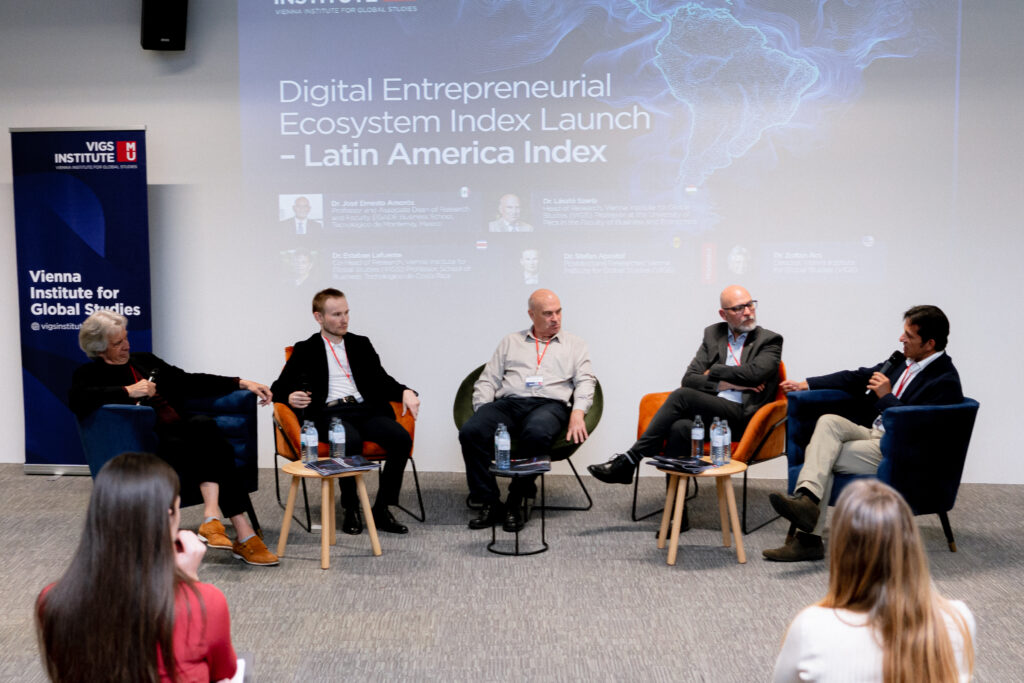
Laszlo Szerb addressed broader global trends, particularly the question of whether digitalisation is reducing or reinforcing economic disparities between countries. While lower-income economies are making relatively fast progress, he noted that structural differences persist, especially in entrepreneurial capacity. Without stronger local ecosystems, he warned, domestic markets risk being dominated by large international platforms.
A recurring theme throughout the discussion was the role of education and inequality. Prof. Dr. Acs highlighted the lack of broad-based educational progress as a key barrier, while Amorós emphasised that gaps in digital literacy and socio-economic inequality continue to limit the effective use of technology across the population.
The event concluded with an interactive discussion on regional integration, fintech growth, market fragmentation, and global value chains. Speakers emphasised that while Latin America has made important progress, its future competitiveness will depend on strengthening education systems, reducing structural inequalities, and fostering ecosystems that support scalable, technology-driven entrepreneurship.
Overall, the launch highlighted both the promise and the limitations of digital development in Latin America, presenting the region as one with significant potential but still facing critical structural challenges that must be addressed to fully participate in the global digital economy.