
The Vienna Institute for Global Studies (VIGS), in partnership with weXelerate, organized the official launch of the Digital Entrepreneurship Ecosystem (DEE) Index Report for the Danube Region.
The event brought together policymakers, ecosystem builders, researchers, and entrepreneurs to explore the digital strengths and structural gaps shaping entrepreneurship across Central and Southeast Europe.
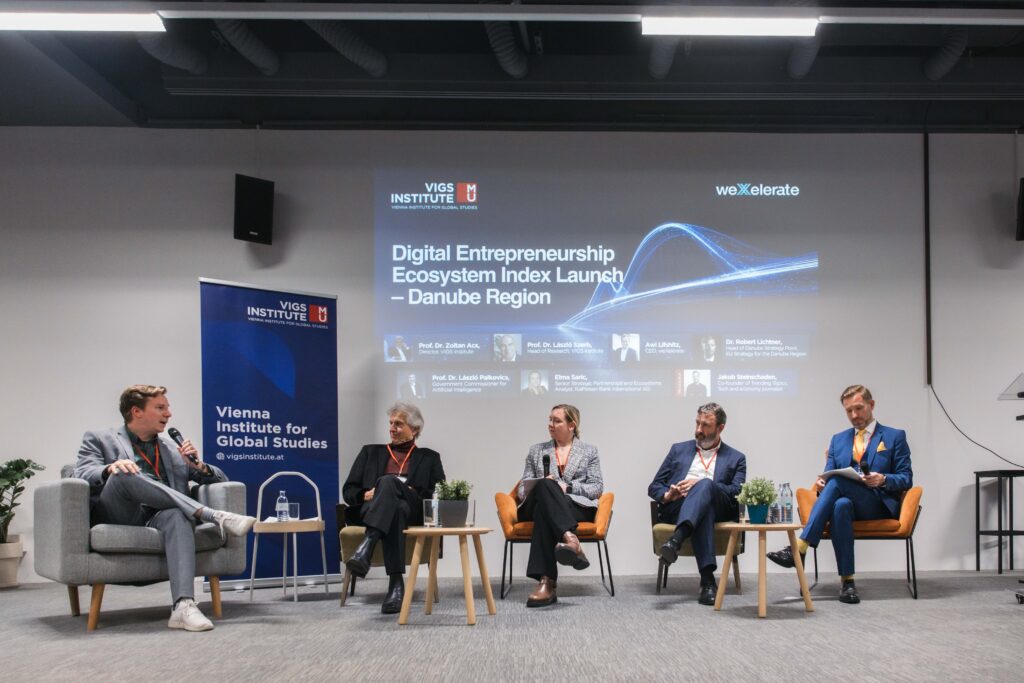
Images: Konrad Gerger
A Milestone for VIGS and the Region
Opening the evening, representatives from the Vienna Institute for Global Studies (VIGS) described the launch as a defining milestone, reflecting the institute’s growth and marking its most significant research output since its founding in Vienna in 2024.
“The DEE Index is our first complex product covering 170 countries, over 50 indicators, and a six-year timeframe from 2017 to 2022,” the team noted. “It reflects not only research excellence but also our commitment to shaping data-driven strategies for innovation and growth.”
The Digital Entrepreneurship Ecosystem Index measures how conducive each country’s environment is for digital entrepreneurship across policy, finance, culture, and infrastructure.
By comparing 12 countries from the Danube Region and including Germany as a benchmark, the report identifies both frontrunners and laggards, creating a factual foundation for cooperation and targeted reforms.
Opening Remarks: Facilitating the Next 25
Prof. Dr. Zoltán Ács, Director of the Vienna Institute for Global Studies, set the tone for the launch:
“Innovation doesn’t happen in a vacuum. Ecosystems shape entrepreneurs, and entrepreneurs shape the future. With the DEE Index, we now have a shared language to talk about the digital readiness of the Danube Region, grounded in data, not assumptions.”
Reflecting on VIGS’s mission to decode complexity and drive long-term transformation, Prof. Dr. Acs emphasized the regional dimension of innovation:
“Facilitating the next 25 years is our motto. The next 25 years will determine whether Europe remains a player or becomes a spectator in the global tech economy.”
He further explained that VIGS’s research focuses on three intersecting pillars: well-being, geopolitics, and entrepreneurship, and that the DEE Index sits precisely where innovation meets societal progress.
“Without data, think tanks become commentators. With data, they become change agents,” Prof. Dr. Acs said.
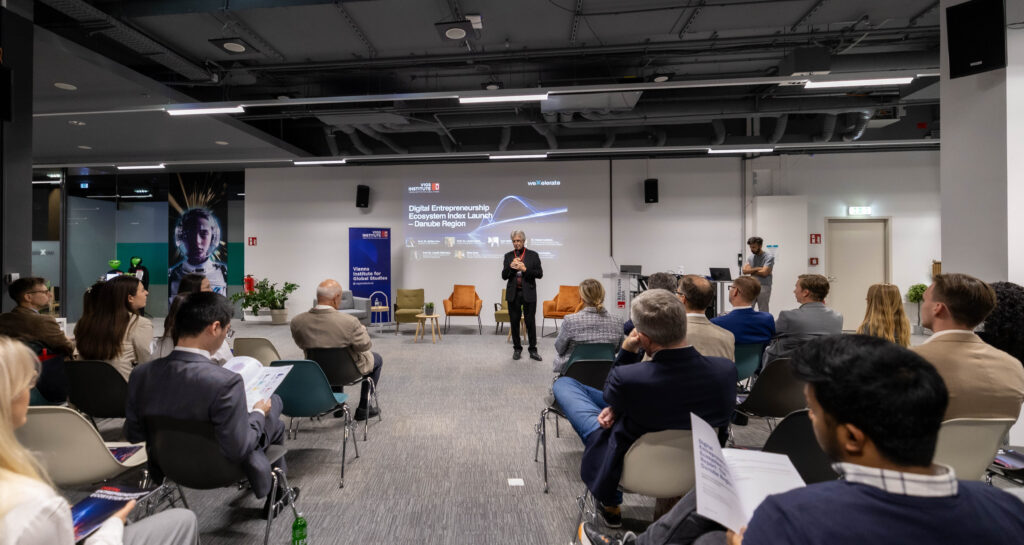
Regional Perspective: Building an Innovation Corridor
Awi Lifshitz, CEO of weXelerate, emphasized the practical importance of regional collaboration:
“Innovation knows no borders. Austria’s innovation ecosystem has grown tremendously, but if we remain small and closed, we miss the real potential. Connecting startups, universities, and accelerators across the Danube is how we multiply growth.”
He observed that while corporate innovation offices across Europe have been downsizing, startup activity is surging, with more than 80 percent of weXelerate’s latest accelerator applications coming from the Danube area.
The DEE Index, he added, provides “the research backbone” to support these observations and to guide policy toward deeper regional cooperation.
Mapping the Digital Divide
Prof. Dr. László Szerb, Head of Research at VIGS and lead architect of the DEE Index, presented the report’s key findings.
He highlighted stark variations in digital readiness, with Western Danube countries leading in infrastructure and innovation, while others lag in finance access, regulation, and entrepreneurial culture.
“In much of Central and Eastern Europe, entrepreneurship as a concept simply didn’t exist 50 years ago under communist rule,” Prof. Szerb said. “Building that culture takes generations, but we are on the way.”
Prof. Dr. Szerb called for targeted interventions rather than blanket policies:
“We don’t need more resources everywhere. We need smarter allocation. The DEE Index helps us pinpoint where focused action makes the biggest difference.”
Policy and Competitiveness
Prof. Dr. László Palkovics, Government Commissioner for Artificial Intelligence, discussed how policy, education, and industry must align to accelerate digital transformation.
He noted that Europe still trails in risk-taking culture and early-stage startup funding, warning that large corporations alone cannot sustain innovation.
“For decades, Europe believed that large corporations were the engines of innovation. But that model no longer holds. Today, startups and universities are the true sources of new ideas, and they need urgent support.”
Cooperation Beyond Borders
Dr. Robert Lichtner, Head of Danube Strategy Point, emphasized that the DEE Index offers a framework for regional alignment:
“If the Danube Region wants to act as one innovation corridor, we need a shared understanding of where each country stands. This index gives us that map.”
Elma Saric, Senior Analyst at Raiffeisen Bank International, underlined the financial sector’s role in supporting entrepreneurship:
“We see a gap in startup financing across Central and Eastern Europe. Banks and investors must collaborate to close it, or we risk losing talent and innovation to other regions.”
From Data to Action
Moderator Jakob Steinschaden, co-founder of Trending Topics, steered a dynamic discussion on culture, capital, and digital policy, capturing the evening’s spirit with a call to action:
“We’ve already discussed data, cooperation, and opportunity. Now the next step is obvious. It’s time to move from talk to action and make innovation happen.”
As the event closed, speakers shared a collective vision. The Danube Region, with its industrial expertise and educational excellence, can become a pan-European innovation hub if collaboration, risk-taking, and policy innovation advance together.
“Designing better ecosystems is not about imitation, it’s about cooperation,” Acs concluded. “The Danube can show how regional innovation can drive well-being and competitiveness.”

About the DEE Index
The Digital Entrepreneurship Ecosystem (DEE) Index was developed by the VIGS research team led by Prof. Dr. Zoltan Acs, Prof. Dr. László Szerb, and Dr. Stefan Apostol.
It provides a comprehensive framework for assessing and comparing digital entrepreneurship capacity across the Danube Region, measuring key pillars such as digital infrastructure, culture, human capital, access to finance, innovation support, and governance quality.
“What gets measured gets improved,” said Szerb. “The DEE Index allows policymakers and entrepreneurs to see clearly where they stand, how they compare, and what comes next.”
Looking Ahead
The evening concluded with a networking reception, where participants from across the Danube Region exchanged ideas on translating research into partnerships and policy.
For VIGS, the DEE Index represents both a scientific achievement and a strategic tool, a foundation for evidence-based policymaking and a call to think regionally in the digital age.
“The future of digital entrepreneurship in the Danube Region will not be written by chance,” Acs said. “It will be shaped by those who choose to collaborate.”