Today, Singapore and Taiwan impress with their high living standards and are driving forces in technological development. The COVID-19 pandemic illustrated the West’s dependence on Taiwan, the small, self-governed island that is currently diplomatically recognized by only twelve countries. The Taiwan Semiconductor Manufacturing Company (TSMC) dominates global production of the most advanced microchips. The so-called “Silicon Shield” is seen as a safeguard against a potential invasion by China. TSMC is currently building its first semiconductor plant in Europe, in Dresden, in a joint venture (the European Semiconductor Manufacturing Company, ESMC) with Bosch, Infineon, and NXP. The EMSC, though, will produce mature, robust nodes optimized for the automotive and industrial sectors rather than the most advanced nodes. Another major Taiwanese company is Foxconn, the world’s largest electronics contract manufacturer, is best known for assembling iPhones in China, India, Vietnam, and other Asian countries.
The even smaller city-state of Singapore with only 6 million inhabitants is a global leader in digital infrastructure and in the adoption of artificial intelligence by both the public sector and private companies. Moreover, it has gradually developed into a regional financial, trade, and logistics hub. The port of Singapore is one of the world’s busiest container ports. It is strategically located on the Strait of Malacca, through which one-third of global trade, including Europe’s trade, is shipped. Both Singapore and Taiwan are major investors in Asia (including China) and in Europe. They also have world-class universities, attracting eminent researchers. Not astonishingly, the Vienna Institute for Global Studies (VIGS) ranks Singapore 7th globally in the Digital Entrepreneurship Ecosystem Index; Taiwan is listed in the “Followers“ cluster.
About 60 years ago, this high level of development was unimaginable. From the 1960s onward, Singapore and Taiwan became role models for socioeconomic and technological development. Both had strong, authoritarian governments: since its independence in 1965, Singapore has been ruled by the People’s Action Party; Taiwan was until 2000 ruled by the Kuomintang, which had lost the civil war in mainland China against Mao’s Communist Party in 1949. Led respectively by the charismatic leaders Lee Kuan Yew and Chiang Kai-shek, the governments steered economic development, identified growth sectors, and incentivized state-owned and private companies with financial support and, at times, direct pressure to invest. Both governments also had strong influence over trade unions and the central bank and were thus able to control wage levels and interest rates. While Lee Kuan Yew remains widely respected as Singapore’s founding father, Chiang Kai-shek’s legacy is far more controversial.
Despite a high degree of state intervention, both Singapore and Taiwan remained capitalist. Being pro-Western-oriented, they benefited during the Cold War from the United States’ open-market policies, foreign direct investment, and technology transfer from Western countries and in particular Japan. Japan was regarded as an inspiring model for success, and Japanese companies invested heavily in Asia in the 1970s. The integration into the world economy and the export-oriented development model were key to the rapid progress of Singapore and Taiwan. Other governments, particularly in Latin America and Africa, pursued import substitution and protectionism, gradually falling economically behind the dynamic Asian tiger economies.
While Singapore and Taiwan share many similarities in their rapid economic development, the evolution of their political systems differs strongly. Like South Korea, Taiwan provides evidence for a famous liberal thesis: at a certain stage of development, citizens demand respect for human and civil rights, the rule of law, and democracy. Since the 1990s, Taiwan has become a role model for a vibrant, democratic society with free media; notably, students are very politically active. It is also a pioneer in legalizing same-sex marriage.
Singapore, on the other hand, has remained since independence an illiberal democracy where no change of power has yet occurred. Both opposition parties and the media face severe formal and informal limitations. The ruling People’s Action Party justifies its hold on power with the narrative of a small, vulnerable state that must always be one step ahead of its peers. For this, so the argument goes, a strong government is necessary. However, as the example of Taiwan demonstrates, maintaining strong economic development and high living standards is also possible in a democratic system.
Due to the de-risking strategy of the European Union – aimed at lessening dependence on China by diversifying supply chains and finding alternative technology partners, notably in regard to developing and producing semiconductors – the importance of Singapore, Taiwan, and other Asian countries will further increase in the coming years. The EU countries are already major investors and trading partners for both, thus there is a strong basis of trust to further deepen economic and technological collaboration. However, when aiming to strengthen their relations with Taiwan, EU member states must always take into account possible criticism or even countermeasures from China. Moreover, governments and companies must remain prepared for potential geopolitical shocks, such as a crisis in the South China Sea or a conflict between China and the United States over Taiwan.
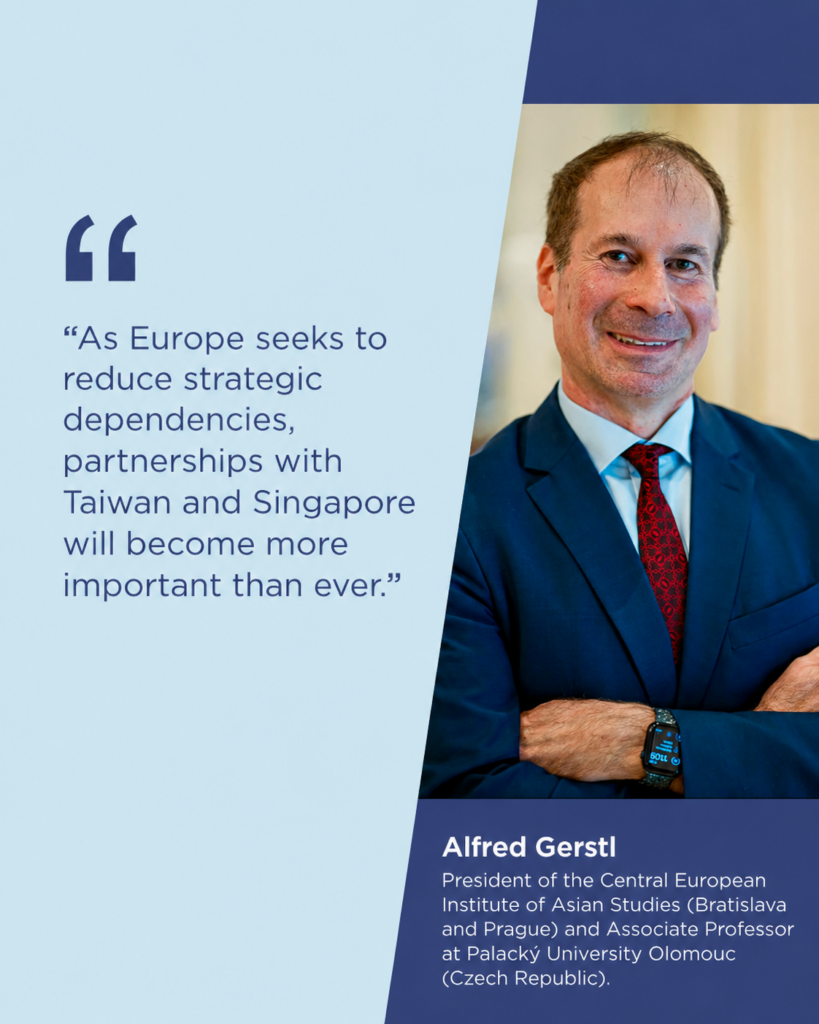
Alfred Gerstl is President of the Central European Institute of Asian Studies (Bratislava and Prague) and Associate Professor at Palacký University Olomouc (Czech Republic).
Work on this article was funded by the EU NextGenerationEU through the Recovery and Resilience Plan for Slovakia under the project No. 09I03-03-V04-00462.